|
Kingdom - Plantae
Division - Ginkgophyta
Class - Ginkgoopsida
Order - Ginkgoales
Family - Ginkgoaceae
Genus – Ginkgo L. Species – ginkgo biloba L. (USDA [USDA],
)
Highlights
Gingko biloba “may cure Alzheimer's disease, increase circulation, tastes like almonds and smells like rancid
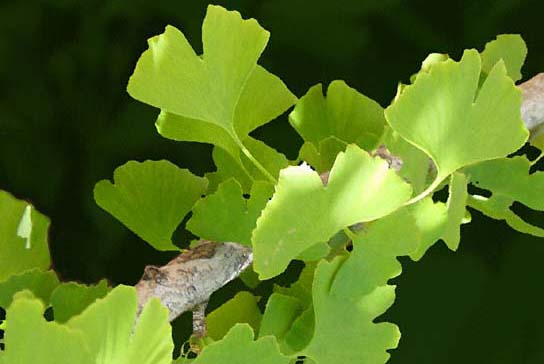
butter” (University of California Museum of Paleontology) This tree lives in temperate areas of the world. The leaves are a unique fan shape that is the distinguishing
feature that places them in the Ginkgophyta division. It can grow 40 –70 feet tall depending on the variety. Ginkgoes
were almost extinct at one point, but since the Chinese propagated it, it has come back. In China, the gingko biloba is considered sacred by Buddhists. It has been planted in many
countries now. It can withstand poor growing conditions, and air quality. Ginkgo leaf extract is believed to have medicinal
properties. The first mention of this was in 2800 B.C. (The Green Web Exotic Seeds) The fruit of the female tree has an undesirable
foul odor, because it contains butyric acid, and also can be caustic to skin, similar to poison ivy. However, after the outer
coating is removed, (while wearing gloves!), the seed is edible. The ginkgo biloba or maidenhair tree has changed little since
prehistoric times. It is the only surviving member of its Division, Ginkgophyta. The common name, maidenhair tree was
given to this tree because of the leaves resemblance to the maidenhair fern. The name ginkgo comes from a word that means
silver apricot. It can live to be over 1,000 years old.
Conservation issues
Female trees are undesireable
because of the noxious fruit they drop.Therefore, "trees are almost exclusively propagated from cuttings (asexual).(to assure
male trees) This has resulted in a loss in genetic diversity under cultivation worldwide.” (Storey)
It is believed to be extinct
in the wild.
G. biloba, are still on the
"New York
Botanical Garden Threatened and Endangered Plant List”.(The Green Web Exotic Seeds) G. biloba are on the list of globally threatened taxa
of vascular plants.(World Conservation Monitoring Centre and United Nations Monitoring Programme, 2001)
Bulleted highlights
*
Ginkgo biloba
is the only living plant in its division.
* This tree has
not changed much since prehistoric times.
* It has been shown
to have medicinal value. * Although g.biloba is cultivated and planted by humans, it is endangered,
and at risk for loss of biodiversity because of propagation by cuttings rather than by seed, due to humans preferance
for male trees.
|